Can ChatGPT Find Your Business? How to Get Discovered in AI Search in 2026

At a Glance
- AI is changing how people discover businesses and professionals, alongside traditional search.
- Foundational SEO still matters: clear, accurate, people-first content remains the basis for AI-search visibility.
- Complete, consistent business information helps AI systems and search engines understand what a business does and who it serves.
- Reviews and independent mentions can strengthen trust, though they are one signal among many.
- A Matchouse profile can help build a clearer, connected digital presence, but no platform can guarantee an AI recommendation.
Search is changing from links to answers
When someone asks ChatGPT, Google or another AI assistant to recommend a business like yours, will your name appear?
A decade ago, "search" meant typing two or three keywords and scanning ten blue links. Today, the same person is more likely to type, or speak, a full question: find a reliable electrician near me with recent reviews, which marketing consultant works with small businesses, find an estate agent experienced in my area, who can help manage a rental property, find a trusted web designer for a startup.
That shift shows up across several channels at once: traditional organic results, local map results, Google's AI Overviews and AI Mode, conversational assistants such as ChatGPT and Microsoft Copilot, and newer product and service discovery features like the visual product cards OpenAI introduced inside ChatGPT in March 2026.
Ofcom, the UK's communications regulator, has tracked how fast this has moved. Its research found that ChatGPT recorded around 1.8 billion visits from UK users across the first eight months of 2025, up from 368 million over the same period in 2024. That measures visits rather than unique people, but the direction is unmistakable: a meaningful share of UK discovery journeys now pass through an AI assistant rather than a traditional search box.
Businesses themselves are moving too. The Office for National Statistics found that self-declared AI use among UK businesses with 10 or more employees rose from around 12% in September to October 2023 to around 35% by June 2026. The ONS is clear that this counts any self-reported use of AI, not depth of adoption; only around one in ten of those AI-using businesses describe their use as extensive, and the survey does not cover every sector. Read narrowly, that is what the figure says: rising awareness and experimentation, not universal, deep integration.
Regulators are paying attention too. In June 2026, the UK's Competition and Markets Authority announced new requirements for Google to rank organic results, including within AI Overviews, using objective and non-discriminatory criteria, and to give businesses more transparency about ranking changes. That is a direct acknowledgement that search, AI features included, remains a critical gateway between UK businesses and their customers.
None of this makes traditional search or word of mouth irrelevant. It means a business's information now needs to hold up in more places and in front of more systems than before.
In short: ChatGPT and other AI-powered search experiences can use information available through the web and connected data sources to help answer recommendation questions. No business can guarantee it will be selected. What a business can do is maintain clear, accurate, useful and trustworthy information across its website and relevant platforms.
Can ChatGPT actually find your business?
The honest answer is: sometimes, indirectly, and never with a guarantee.
According to OpenAI's help documentation, ChatGPT search turns a request into one or more web queries, retrieves relevant results, and generates an answer, often with inline citations, sometimes via partner search providers. It does not maintain a hidden directory of every UK business; it leans on the open web and, for specific commercial features, data supplied directly by merchants.
That last point matters. In March 2026, OpenAI described a richer product discovery experience inside ChatGPT, built on its Agentic Commerce Protocol, where merchants supply a structured product feed the system ingests directly. This is a distinct mechanism from general conversational search, aimed at retail products, not local professionals in general, though a lot of AI-search advice online blurs the two.
It also helps to separate outcomes often talked about as if they were the same thing:
- Being indexed, a page has been crawled and stored.
- Being mentioned, a business's name appears somewhere in the content a system draws on.
- Being cited, an AI answer links directly to a business's page as a source.
- Being recommended, the AI names the business as a suggested option.
- Receiving a click, an enquiry, and eventually new business are three further, separate steps.
A business can be indexed without being cited, cited without being recommended, recommended without anyone clicking through. Each stage depends on the one before it, and AI-search visibility only ever influences the earliest stages of that chain.
Where AI systems may learn about a business
No AI provider publishes the exact formula it uses to select and rank sources, and none of the official documentation reviewed for this article describes one. What is documented is the type of information these systems can draw on, which overlaps heavily with what search engines have always used: a business's own website, Google Business Profile and equivalent listings, trusted marketplace and directory profiles, professional associations, customer reviews, news coverage, social profiles, structured data, product feeds, and other sites that link to or mention the business.
The instinct many businesses have is to try to appear everywhere. A more useful instinct is consistency. If a business's name, address, phone number and services say slightly different things on five platforms, every system reading that information has to work harder to decide which version is correct. Clarity across a smaller number of accurate sources tends to help more than a scattergun approach across dozens of low-quality ones.
Why good businesses remain invisible
It is entirely possible to run an excellent business and still be difficult to find. In practice, the same gaps come up again and again:
- Incomplete profiles with missing services, locations or contact details
- Vague descriptions that never state exactly what is offered or to whom
- A business name, phone number or address that is inconsistent across platforms
- Outdated opening hours, few or no recent reviews
- Services described only inside images, which most systems cannot read
- Pages that cannot be crawled, or that duplicate content with no clear original source
- A poor mobile experience, on a web increasingly browsed on a phone
- Thin, generic AI-written pages with no visible evidence of expertise
- No independent mentions beyond the business's own channels
A good business can still be invisible. That is the problem underneath all of this, whether the person looking is scrolling Google, asking ChatGPT, or comparing three plumbers before Friday.
The signals that help AI and search engines understand a business
Google's own guidance on optimising for generative AI search is direct: "the best practices for SEO continue to be relevant because our generative AI features on Google Search are rooted in our core Search ranking and quality systems." Four categories of signal come up consistently across the official sources reviewed here.
Identity. A consistent business name, public contact information, a clear location or service area, an accurate category, and a working website.
Relevance. Clear descriptions of services, the locations and problems solved, dedicated pages for distinct services, and answers to the questions customers actually ask.
Trust. Genuine reviews, current ratings, case studies, qualifications and mentions from sources the business does not control. Google's guidance on local ranking lists reviews and ratings, alongside links and mentions, as contributing to prominence, one of three factors behind local results. Google is equally explicit that there is no way to pay for a better local ranking.
Freshness and technical accessibility. Updated services and details, recent reviews, and a technically sound website: crawlable pages, semantic HTML, a fast mobile experience, correct canonical URLs and meaningful image alt text. Bing's webmaster guidelines echo the same fundamentals, rather than any AI-specific trick.
Ten practical ways to improve your AI-search visibility
- Build one clear digital identity. Use the same business name, address, phone number and description everywhere. Action: audit your top five profiles this week and fix any mismatch.
- Complete every important profile field. An empty field is a missed chance to be understood. Action: fill in anything left blank on your website and Google Business Profile.
- Describe services in the language customers use. "Emergency callouts for burst pipes" tells a system, and a person, more than "plumbing services." Action: rewrite one vague description this week.
- Create pages that answer real customer questions. A short page answering "how much does X cost" beats a long, unfocused about page. Action: list the five questions customers ask most, then check your site answers them.
- Keep your name, address and contact details consistent. Inconsistency is a common, fixable reason a business looks unreliable. Action: search your business name and check what the first page of results shows.
- Collect genuine, detailed and recent reviews. A handful of specific recent reviews often carries more weight than dozens of generic ones. Action: ask your next three satisfied customers to mention the actual work done.
- Add evidence of expertise. Case studies and accreditations give customers and AI systems something concrete to point to. Action: publish one short case study with the problem, approach and outcome.
- Earn relevant third-party mentions. A mention from a trade body or local publication is worth more than a purchased link. Action: identify one credible organisation you could realistically be mentioned by.
- Make important information accessible to search engines. Text hidden inside images or blocked pages cannot be read. Action: check your core pages are not blocked in robots.txt.
- Measure visibility and update information regularly. This is not a one-off project. Action: set a quarterly reminder to review hours, services, prices and portfolio.
Do reviews help businesses appear in AI recommendations?
Reviews help customers assess a business, and they give AI systems useful context. Google's local ranking guidance states plainly that review volume and positive ratings can contribute to prominence, a genuine, documented signal. It is not, however, a guarantee of an AI recommendation on its own; reviews sit alongside relevance and distance, and none of the AI providers reviewed for this article claim reviews alone determine what gets cited or recommended.
Detailed, specific reviews describing what was actually done are more useful than repetitive generic ones, and recent reviews help anyone assessing a business understand whether it remains active. Businesses should never buy, fabricate or manipulate reviews: beyond breaching most platforms' terms, manipulated reviews create a false picture that erodes trust the moment a customer notices the gap.
Note: Genuine, recent, detailed reviews support both human trust and AI-search context. They do not, on their own, guarantee that an AI assistant will recommend a business by name.
What businesses should not do
Manipulative tactics tend to backfire, because they optimise for a system's assumed weaknesses rather than genuine clarity.
- Publishing hundreds of thin, AI-written pages with little original value
- Copying competitors' content instead of describing your own service
- Buying fake reviews or creating false locations or service areas
- Making unsupported "best in the UK" or "number one" claims
- Adding structured data that misrepresents what a page actually contains
- Hiding important service information inside images with no text alternative
- Assuming an llms.txt file guarantees inclusion, when Google states plainly that "you don't need to create new machine readable files, AI text files, or markup to appear in these features"
- Repeating keywords unnaturally instead of writing for a human reader
- Claiming accreditations or qualifications the business does not actually hold
Each of these can create a short-term illusion of authority. Over time, they tend to reduce trust, with customers who notice the gap and with systems that increasingly cross-check information against other sources.
How Matchouse helps businesses and professionals become easier to discover
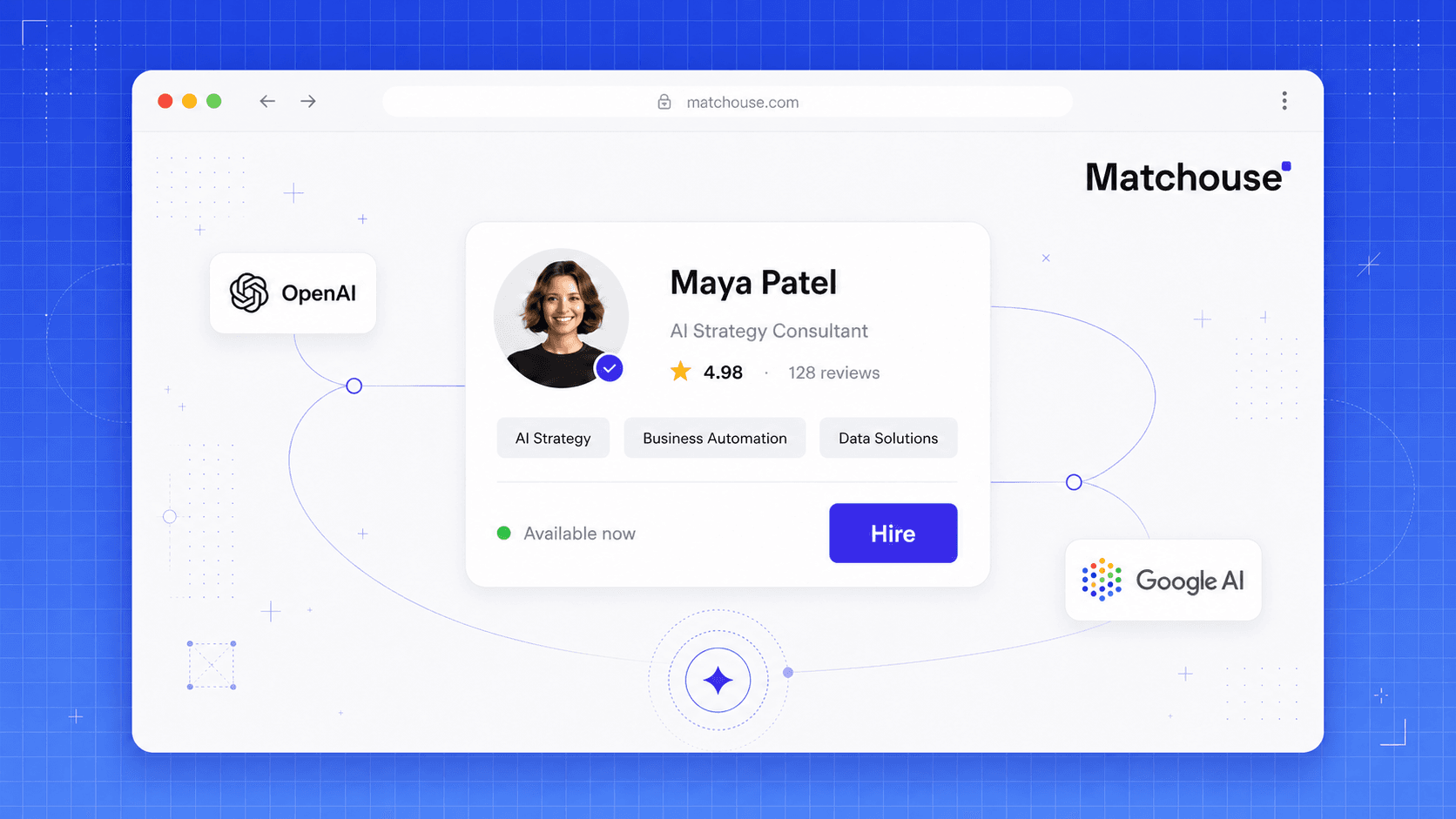
A business's information is often scattered: a website here, a social profile there, reviews split across platforms, no single place showing the full picture. Matchouse exists to bring that picture together, as a connected marketplace where businesses, professionals and customers can discover one another, build trust, connect and create opportunities.
One clearer professional identity. A Matchouse profile gives a business or professional one place to present who they are, what they offer and how people can get in touch.
Services explained in context. Businesses and professionals can list their services with real detail rather than a vague one-line bio.
Reviews that support customer trust. Reviews on a Matchouse profile help potential customers understand what a professional is known for, building on the same trust signal Google already recognises.
Discovery across a connected marketplace. Matchouse brings properties, services and professionals into one place rather than one narrow category, so a landlord, a homeowner and a small business owner can all search the same marketplace.
Direct connection and opportunity. Where supported on the platform, people can move from discovery straight into contact, an enquiry, a posted job, or a booking.
A profile that grows with the user. The same person might be a tenant this year and a landlord next, reflected in Matchouse's dedicated pages for tenants, landlords, buyers, estate agents and service providers.
Creating a Matchouse profile does not guarantee that ChatGPT, Google or another AI platform will recommend your business. It can, however, help you build a clearer and more trustworthy public presence that customers and search technologies can understand.
How Matchouse helps customers and service seekers
This is not only a story about businesses trying to be found. It is also about the person doing the finding. An AI-generated answer should be treated as a starting point, not unquestionable proof. Before committing to any business or professional, it is worth checking:
- The provider's identity and how long they have been operating
- Relevant experience and examples of similar work
- The exact services offered and the area they cover
- Recent, detailed reviews rather than a single star rating
- Qualifications, accreditations or insurance where the work requires them
- Clear pricing and cancellation or refund terms before any work begins
- Whether the claims made can be independently verified
- Whether communication stays on a secure, traceable channel
A Matchouse profile is designed to make several of these checks easier in one place: services, reviews and contact details together, rather than spread across a website, a social profile and a review site that may or may not be current.
A practical AI-discovery checklist
| Area | Question to check | Action |
|---|---|---|
| Identity | Is the business name consistent everywhere it appears? | Correct any inconsistent listings |
| Services | Are services explained clearly and specifically? | Add detailed, specific descriptions |
| Location | Is the service area clearly visible? | Add accurate location and coverage information |
| Reviews | Are there genuine, recent reviews? | Ask recent customers for honest feedback |
| Website | Can important pages actually be indexed? | Check robots.txt and meta robots directives |
| Trust | Is expertise backed by visible evidence? | Add qualifications and examples of past work |
| Profiles | Are public profiles, including Matchouse, complete? | Fill in every relevant profile field |
| Measurement | Is visibility being tracked at all? | Review Search Console and Bing Webmaster Tools |
How to measure whether AI search is finding you
There is no single dashboard for "AI visibility" the way analytics tools show website traffic, but there are practical ways to build a picture. Ask realistic discovery questions across different tools using private browsing, and treat any single answer as one data point, not a definitive result.
Beyond that, review Google Search Console, and review Bing Webmaster Tools, which has introduced AI Performance reporting showing how often a site's content is cited in AI-generated answers across Microsoft Copilot. A citation is a source being referenced inside an answer, not a click or a conversion. Track branded search impressions, profile views and enquiries, and note where new customers say they first heard of you.
Repeatedly typing your own business name into AI tools will not influence future answers. Time is better spent fixing the underlying information these systems draw on.
The future of business discovery
The direction of travel is fairly clear, even as the exact tools change. Discovery is becoming more conversational, more personalised, and more contextual, drawing together information from several sources rather than a single ranked list. It is also becoming more dependent on clear, consistent data, more connected to reviews and reputation, and more likely to move straight from discovery into contact, a booking, or a purchase.
That points to one underlying requirement, regardless of which platform a customer happens to be using: information that is accurate, consistent and easy to evaluate, wherever someone encounters it.
Editorial note: AI-powered search products and their features can change quickly. This article reflects information available on the publication date and will be reviewed as platforms update their search and recommendation experiences.
Conclusion
Customers cannot choose a business they cannot find, understand or trust. That has always been true; AI search has not changed it so much as raised the stakes.
The objective was never to manipulate an AI system into naming a particular business. It is to make that business clearer, more useful, more trustworthy and easier to evaluate, wherever discovery happens to take place: a Google search, an AI Overview, a conversation with ChatGPT, or a recommendation from a friend.
Bring your presence together on Matchouse
Bring your profile, services, reviews and opportunities into one connected presence, and make it easier for the right people to discover and understand what you offer.
Create your Matchouse profile
Looking for a trusted business or professional?
Explore verified businesses, professionals and services already connected through Matchouse.
Explore businesses and professionals
Frequently asked questions
Can ChatGPT recommend my business?
It can reference information it finds through web search and connected sources, and that may include your business. It cannot be guaranteed.
How does ChatGPT find information about businesses?
Per OpenAI's documentation, ChatGPT search generates web queries, retrieves results and produces an answer, often with citations, sometimes via partner search providers. It is not a hidden directory of every business.
Can I pay ChatGPT to recommend my company?
No. There is no verified mechanism to pay OpenAI, Google, Microsoft or any provider for a guaranteed AI recommendation. Treat any service claiming to sell one with scepticism.
Does a Google Business Profile help with AI search?
A complete, accurate profile supports local visibility in Google's own systems and is one source AI systems may draw on. It does not guarantee inclusion in a specific AI answer.
Do customer reviews improve AI-search visibility?
Reviews are a documented contributor to prominence in Google's local ranking guidance and give AI systems useful context, but they are one signal among several.
What is generative engine optimisation?
The emerging practice of making a website's content and structure clear enough for AI-powered search tools to understand and reference accurately. It overlaps heavily with established SEO.
Do I need special AI schema or an llms.txt file?
No official platform reviewed for this article requires either. Google states directly that no special AI markup, schema or text file is needed to appear in its AI features.
Can a Matchouse profile help people discover my business?
A complete profile strengthens your public presence by bringing services, reviews and contact details into one place. It supports discoverability; it does not guarantee any AI platform will recommend you.
How long does it take to improve online visibility?
There is no fixed timeline, and any source promising one should be treated with caution. Consistent, accurate information maintained over time tends to build visibility gradually.
Further reading and official guidance
- Google Search: AI features and your website, Google Search Central. How AI Overviews and AI Mode identify supporting sites, and why no special AI schema is required.
- Google Search: optimising for generative AI experiences, Google Search Central. Why foundational SEO and people-first content remain the basis for AI-search visibility.
- Understanding local ranking on Google, Google Business Profile Help. Relevance, distance and prominence, and why ranking cannot be bought.
- ChatGPT search, OpenAI Help Centre. How ChatGPT search retrieves and cites web sources.
- Powering product discovery in ChatGPT, OpenAI. The March 2026 product discovery feature and how it differs from general search.
- Bing Webmaster Guidelines, Microsoft Bing. Technical and content standards, including canonical URLs and duplicate content handling.
- AI Performance in Bing Webmaster Tools, Microsoft Bing. How to monitor citations in Microsoft's AI experiences.
- Further CMA action on Google Search services in the UK, UK Competition and Markets Authority, 17 June 2026. New fair-ranking requirements covering AI Overviews.
- Artificial intelligence in UK businesses, Office for National Statistics. Self-declared AI adoption among UK businesses with 10 or more employees.
- SME Digital Adoption Taskforce: 2026 update, UK Government, 26 June 2026. Progress on digital and AI adoption support for UK SMEs.
- From apps to AI search: how the UK goes online in 2025, Ofcom, 10 December 2025. Growth in UK visits to AI tools including ChatGPT.