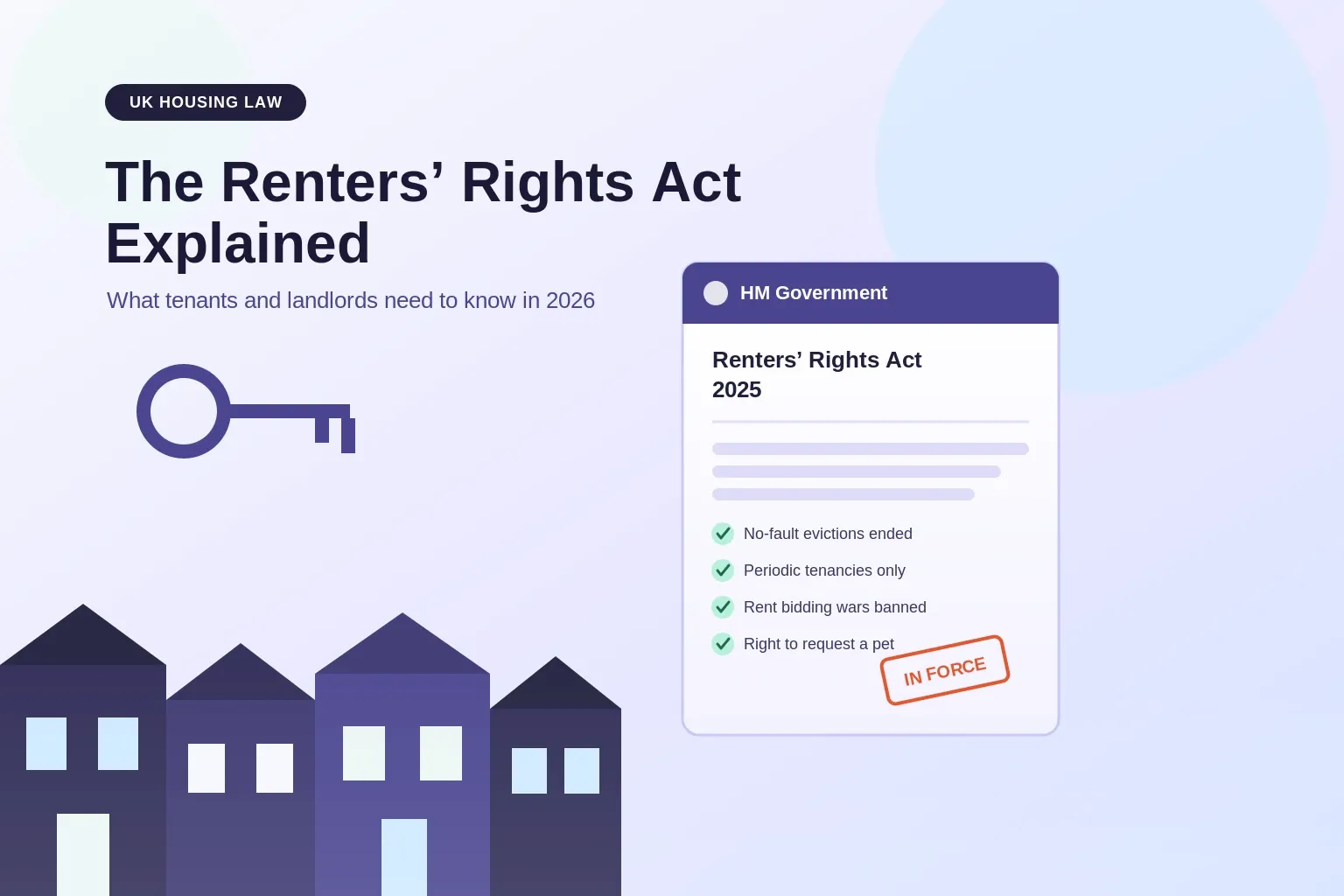
The Renters' Rights Act 2025: What Tenants and Landlords Need to Know

Key Facts
- The Renters' Rights Act 2025 received Royal Assent on 27 October 2025, with the main reforms coming into force on 1 May 2026.
- Section 21 "no-fault" evictions have been abolished — landlords must now give a legal reason (a "ground") to end a tenancy.
- All assured shorthold tenancies became rolling periodic tenancies, with no more fixed terms.
- Rent can only rise once a year, and tenants can challenge above-market increases at the First-tier Tribunal.
- Rent bidding wars are banned — landlords and agents must publish an asking rent and cannot accept offers above it.
- Tenants now have a statutory right to request a pet, and blanket bans on benefit claimants and families are unlawful.
- A new Private Rented Sector Database and mandatory Landlord Ombudsman are being phased in from late 2026.
🏘️ Introduction
If you rent a home in England, or you let one out, the rules changed significantly this year. The Renters' Rights Act 2025 is the biggest shake-up of the private rented sector in over 30 years, and its central reforms took effect on 1 May 2026.
Whether you're a tenant wondering what security you now have, or a landlord working out what you need to change, this guide breaks down exactly what's new, what's still to come, and what it means for you.
Key Fact: The Act applies to the private rented sector in England. Scotland, Wales and Northern Ireland have their own separate tenancy laws.
1. What Is the Renters' Rights Act 2025?
The Renters' Rights Act 2025 rewrites the rulebook for private renting in England. It replaces assured shorthold tenancies (ASTs) with a single system of periodic tenancies, abolishes Section 21 "no-fault" evictions, tightens the rules around rent increases, and introduces new protections against discrimination — all while adding oversight through a national landlord database and an ombudsman service.
The government's stated aim is to rebalance a system that, for decades, gave landlords the power to end a tenancy with two months' notice and no reason given — while giving tenants firmer ground to challenge unfair rent rises, poor conditions and unreasonable refusals around pets or children.
2. When Does It Actually Come Into Force?
The Act is being rolled out in phases rather than all at once.
| Phase | Date | What Happens |
|---|---|---|
| Phase 1 | 1 May 2026 | Section 21 abolished, new periodic tenancy system, rent increase rules, pet requests, discrimination ban, bidding war ban all take effect |
| Phase 2 | Late 2026 onwards | Private Rented Sector Database launches for landlords and councils |
| Phase 3 | 2028 (expected) | Mandatory Landlord Ombudsman sign-up for all private landlords |
| Phase 4 | 2035 | Decent Homes Standard extended to the private rented sector |
Disclaimer: Implementation dates are set by government regulations and can shift. Always check gov.uk or speak to a solicitor for the latest position before acting.
3. The End of Section 21 "No-Fault" Evictions
This is the headline change. Section 21 of the Housing Act 1988 allowed landlords to evict tenants with two months' notice, without giving any reason. From 1 May 2026, that route no longer exists for new or existing tenancies.
- The last date a Section 21 notice could be served was 30 April 2026.
- Landlords with a pending Section 21 notice had until 31 July 2026 to start possession proceedings in court.
- From 1 May 2026 onwards, all evictions must go through Section 8, using a specific legal ground.
- Tenants generally cannot be evicted in the first 12 months of a tenancy on grounds like the landlord wanting to sell or move in.
To regain possession now, a landlord must rely on one of the revised Section 8 grounds — for example, selling the property, moving back in themselves or a close family member, persistent rent arrears, or anti-social behaviour. Crucially, they need to evidence the ground they're relying on, so accurate rent records and paper trails matter more than ever.
4. New Tenancy Structure: Periodic Tenancies Only
Fixed-term tenancies (the classic 6 or 12-month AST) have gone. Every assured tenancy is now a rolling periodic tenancy, running month to month with no end date built in.
Important: For tenants, this means you're no longer locked into a fixed term you can't leave early — you can give notice at any time. For landlords, it means you can no longer rely on a fixed term ending as a reason to regain the property.
Tenants must still give the notice period set out in their tenancy agreement (usually one month) to end the tenancy themselves.
5. Rent Increases and the Ban on Bidding Wars
TIP: Landlords can only increase rent once every 12 months, using the formal Section 13 process — not through a rent review clause buried in the contract.
If a tenant thinks a proposed increase is above the going market rate, they can challenge it at the First-tier Tribunal before it takes effect, free of charge. The Tribunal can only set the rent at or below the landlord's proposed figure, never above it.
The Act also tackles the practice of encouraging tenants to bid against each other for a property:
Rent bidding wars are now banned. Landlords and letting agents must:
- Advertise a clear asking rent for the property.
- Not invite, encourage or accept offers above that advertised rent.
Breaching this rule can lead to a fine of up to £7,000 for a first offence, rising for repeated breaches.
6. The Right to Request a Pet
Tenants can now formally request permission to keep a pet, and landlords cannot unreasonably refuse. Reasonable grounds for refusal include things like the property being genuinely unsuitable, or the building's superior lease banning pets outright.
Note: Landlords can require tenants to have insurance covering potential pet damage, or ask for a higher standard cleaning arrangement at the end of the tenancy — but a blanket "no pets" clause is no longer enforceable on its own.
7. Banning "No DSS" and "No Children" Discrimination
The Act makes it unlawful for landlords and agents to refuse tenants simply because they receive benefits (including Universal Credit) or because they have children. Blanket "No DSS" or "No children" policies — whether in an advert or unwritten practice — are now against the law.
| Before the Act | Under the Renters' Rights Act |
|---|---|
| Adverts could state "no DSS" or "no children" | Blanket bans on benefit claimants or families are unlawful |
| Applicants could be screened out automatically | Each application must be assessed on its individual merits |
8. Private Rented Sector Database and the Landlord Ombudsman
Two new layers of oversight are being introduced gradually:
- A Private Rented Sector Database, requiring landlords to register their properties, expected to roll out from late 2026.
- A mandatory Landlord Ombudsman, giving tenants a free route to raise complaints about repairs, harassment or unfair treatment, with legally binding decisions — expected to become compulsory for all landlords around 2028.
Together, these are designed to make it easier for councils and tenants to identify rogue landlords and to resolve disputes without going to court.
9. What This Means for Tenants
- You have far greater security — no more "no-fault" eviction notices arriving out of the blue.
- You can challenge rent increases you believe are above market rate, at no cost, before they take effect.
- You have a genuine, enforceable right to request a pet.
- You can no longer be turned away simply for claiming benefits or having children.
- You can leave a periodic tenancy by giving notice, without being tied to a fixed term.
10. What This Means for Landlords
- Section 21 is gone — every eviction now needs a valid Section 8 ground and supporting evidence.
- Keep clear, dated records of rent payments, communications and any breaches, in case you ever need to prove a ground for possession.
- Rent reviews must follow the formal Section 13 process, once every 12 months.
- Review pet and "acceptable tenant" policies now, since blanket refusals are no longer compliant.
- Prepare for the Private Rented Sector Database and Ombudsman registration once each phase goes live.
Disclaimer: This article is a general guide and does not constitute legal advice. Every tenancy is different — if you're facing a specific eviction, rent dispute or compliance question, speak to a solicitor, Citizens Advice, or a qualified letting professional.
📈 Key Stats
- Royal Assent: 27 October 2025
- Main reforms in force: 1 May 2026
- First-offence fine for rent bidding wars: up to £7,000
- Minimum gap between rent increases: 12 months
- Landlord Ombudsman expected to be mandatory: around 2028
🌟 Final Thoughts
The Renters' Rights Act 2025 is the most significant change to English renting law in a generation, and its effects will keep unfolding as the Database and Ombudsman phases arrive over the next couple of years. Whether you're renting or letting, the safest move is the same: understand exactly where you stand under the new rules, keep good records, and get proper advice before making any big decisions.
Renting or Letting? Get It Right the First Time
Whether you need a solicitor to review a tenancy agreement, a letting agent, or help finding your next home, post your request for free and get matched with trusted professionals near you.
Get Started